


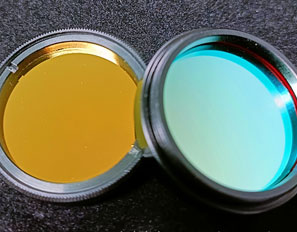
Biomedical Coating Solution
Fluorescence signals in biological applications are inherently weak and often overwhelmed by much stronger excitation light. Optical filters play a critical role in isolating these faint signals with high precision.
Core Challenges
- Ultra-high signal-to-noise ratio (SNR):
Excitation light must be effectively blocked, while fluorescence signals are transmitted with maximum efficiency. - Minimal autofluorescence:
Filter substrates and coatings must not generate any detectable background fluorescence under excitation. - Precise spectral control:
Sharp transition edges and accurate cut-off characteristics are essential to ensure clean signal separation. - High transmission efficiency:
Maximum transmission within the passband is required to capture as many photons as possible. - Angular stability:
The filter response must remain stable under varying angles of incidence to prevent wavelength shifts that could affect quantitative analysis.
Key Filter Types
- Excitation filters:
Positioned before the light source, allowing only specific excitation wavelengths to pass. - Emission filters:
Placed in front of the detector, transmitting fluorescence signals while effectively blocking excitation light. - Dichroic mirrors (beamsplitters):
Typically set at a 45° angle, reflecting excitation light toward the sample while transmitting emitted fluorescence.
Standard Fluorescence Filter Set
A typical fluorescence filter set consists of three components:
Excitation Filter
- Function:
Selects the wavelength range required to excite fluorescent dyes or proteins. - Requirements:
High transmission (>90%) within the excitation band, combined with deep blocking in other regions—especially within the emission range (typically OD 6 or higher).
Dichroic Mirror / Beamsplitter
- Function:
Positioned at an angle (commonly 45°), it reflects excitation light toward the sample and transmits emitted fluorescence to the detector. - Requirements:
High reflectance (>99%) in the excitation band and high transmission (>90%) in the emission band. A very steep transition edge is critical for effective spectral separation.
Emission Filter
- Function:
Further refines the fluorescence signal before detection, transmitting only the desired emission wavelengths while eliminating any residual excitation light. - Requirements:
High transmission within the emission band, combined with extremely deep blocking of excitation wavelengths (OD 6 as a baseline, with OD 8+ required for advanced applications).
This component is critical for achieving high signal-to-noise performance.
Recommended Coating Technology: Ion Beam Sputtering (IBS)
For high-end fluorescence applications—such as confocal microscopy, high-content screening, and flow cytometry—ion beam sputtering (IBS) is widely regarded as the industry benchmark.
Key Advantages of Ion Beam Sputtering
- Ultra-low absorption and scattering:
Coating density approaches that of bulk materials, resulting in minimal optical loss. - Excellent uniformity and repeatability:
Ensures consistent performance across large production batches. - Outstanding environmental stability:
Dense, hard coatings provide long-term durability with minimal sensitivity to environmental factors. - Precise thickness control:
Enables the realization of steep spectral edges and complex multilayer designs.
Although IBS systems involve higher capital cost and lower deposition rates, the resulting performance—particularly in terms of signal-to-noise ratio and long-term stability—is essential for high-value scientific and clinical instruments.
Online Message
标签 optical


