What Is the Role of Composite Current Collectors in Carbon Reduction and Resource Efficiency?
Composite current collectors represent more than just a performance upgrade — they are a key enabler of green manufacturing.
Industry estimates show that when composite aluminum foil production reaches 5 billion m², it can save approximately 140,000 tons of copper resources and reduce 2.3 million tons of CO₂-equivalent emissions.
In the context of global carbon neutrality goals, composite current collectors are expected to deliver significant zero-carbon benefits across the lithium battery value chain.
Leveraging its advanced PVD vacuum coating systems, HCVAC empowers customers to achieve both mass production and a more sustainable, low-carbon manufacturing process.
Which Next-Generation Battery Systems Can Benefit From Composite Current Collectors?
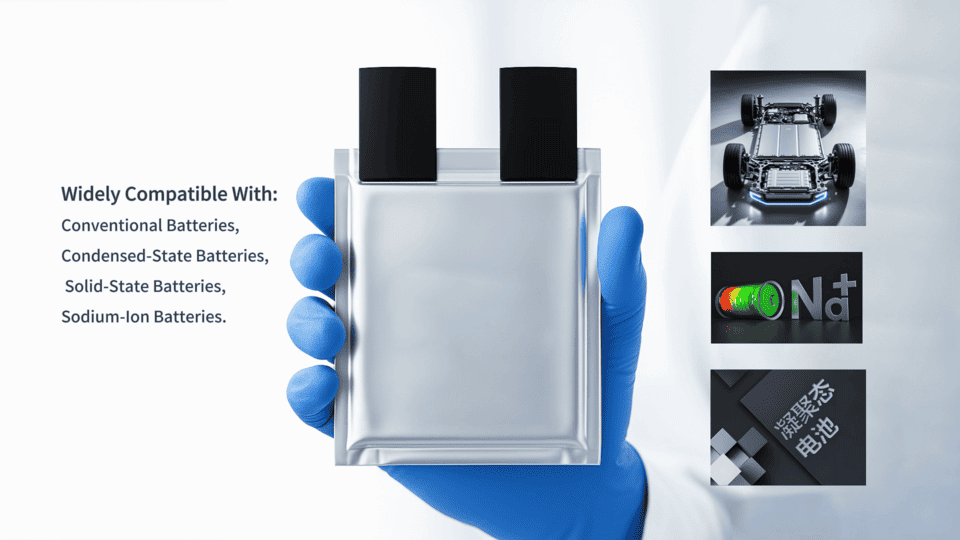
Composite current collectors demonstrate exceptional compatibility across multiple battery systems, including:
- Conventional lithium-ion batteries
- Solid-state batteries
- Condensed-phase batteries
- Sodium-ion batteries
This indicates that composite current collectors are poised to become a next-generation universal platform material for electrochemical energy storage.
According to industry forecasts, China’s shipment volume of composite current collectors is expected to increase more than 300-fold between 2025 and 2030, giving rise to a rapidly emerging multi-billion-dollar industry.
What Are the Limitations of Traditional Metal Current Collectors?
For years, lithium-ion batteries have relied on copper and aluminum foils as current collectors. However, their limitations are becoming increasingly evident:
Pain Point Type | Description |
Weight | Copper foil accounts for approximately 13% of the total battery weight, and aluminum foil about 5%, limiting further improvements in energy density. |
Cost | The high price volatility of copper leads to material costs representing around 9% of the total battery cost. |
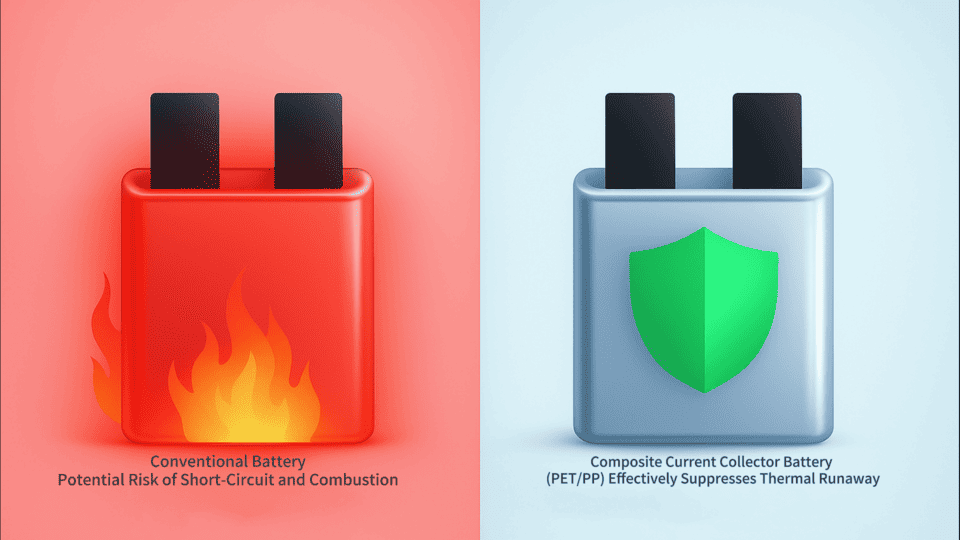
Safety | Copper foils are prone to lithium dendrite penetration through the separator, posing potential thermal runaway risks. |
These challenges have become the “hidden costs” of industrial upgrading, driving the rapid adoption of composite current collectors as the new mainstream solution.
What Are the Significant Performance Advantages of Composite Current Collectors?
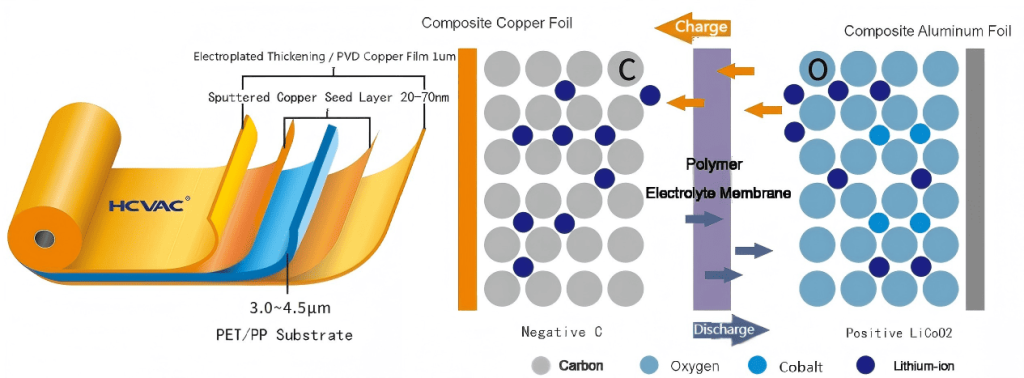
Using polymer-based films such as PET and PP as substrates, and applying PVD metallization, composite current collectors demonstrate several notable performance advantages:
- Enhanced Safety: PET-based films are difficult to puncture, suppress lithium dendrite growth, and reduce the risk of thermal runaway.
- Energy Density: Increased by 5–10%.
- Cycle Life: Extended by approximately 5%.
- Excellent Processability: The composite copper foil substrate has a thickness of 3.0–4.5 μm, and single rolls can reach up to 20,000 m, enabling efficient roll-to-roll continuous production.
- Cost Reduction: Achieves around 60% cost savings, realizing a dual breakthrough in both cost reduction and efficiency improvement.
What Key Role Does the PVD Process Play in Composite Current Collectors?
To form a highly conductive and strongly adherent metal layer on a non-metallic substrate, the PVD (Physical Vapor Deposition) coating technology is essential for composite current collectors.
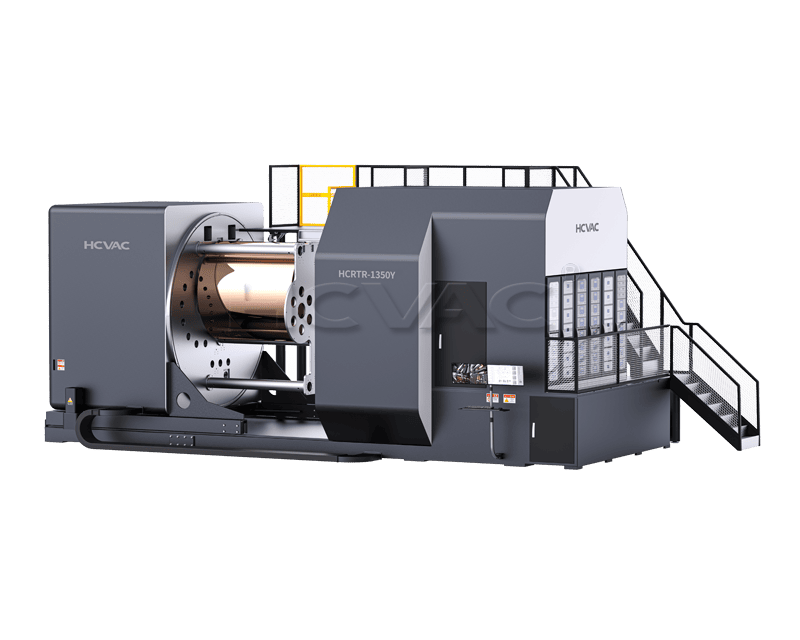
Based on years of experience in vacuum equipment, HCVAC has developed a high-precision magnetron sputtering system optimized for roll-to-roll continuous production, offering the following advantages:
Magnetron Sputtering
- Metal atoms are deposited onto the substrate via plasma bombardment of the target material.
- Enables nano-level thickness control and excellent film uniformity.
- Suitable for large-area continuous production, with lower energy consumption and stronger adhesion.
Evaporation Coating
- Suitable for light metal systems and multilayer composite structures.
- Can be combined with sputtering to create multilayer conductive films, enhancing interfacial bonding and heat resistance.
- Leveraging HCVAC’s roll-to-roll PVD coating system, customers can achieve a complete solution from experimental validation to large-scale production.
What Are the Development Trends of Composite Copper Foil PVD Processes?
As a key direction for composite current collectors, the PVD process for composite copper foil is evolving toward high conductivity, high uniformity, low stress, and low carbonization.
A typical process route includes:
Substrate Surface Pretreatment → Vacuum Coating (Cu/Cr/Ni Multilayer Structure) → Online Thickness Monitoring → Roll-to-Roll Winding
HCVAC’s solution enables:
- Film Thickness Uniformity: Controlled within ±3%.
- Interfacial Adhesion: Greater than 1.5 N/cm.
- High-Density Metal Layer: Stable electrical conductivity.
- Scalability: Meets the requirements of new energy battery manufacturers for high throughput, low energy consumption, and reproducible processes.
How Does HCVAC Enable the Industrialization of Composite Current Collectors?
HCVAC has over a decade of experience in magnetron sputtering and vacuum coating technologies, continuously building domestically manufactured equipment systems for the lithium battery, optical, and electronics industries.
To meet the mass production requirements of composite current collectors, HCVAC offers:
- Roll-to-Roll Magnetron Sputtering Coating Systems: Support continuous production of ultra-long substrate films.
- Intelligent Vacuum Control Systems: Enable precise film thickness and temperature management.
- High-Efficiency Target Utilization and Energy-Saving Design: Reduce energy consumption and material waste per unit.
- Modular, Expandable Production Lines: Adaptable from pilot-scale to large-scale manufacturing.
With strong process adaptability and equipment reliability, HCVAC is working with industry partners to drive the large-scale, low-carbon, and intelligent production of composite current collectors.